

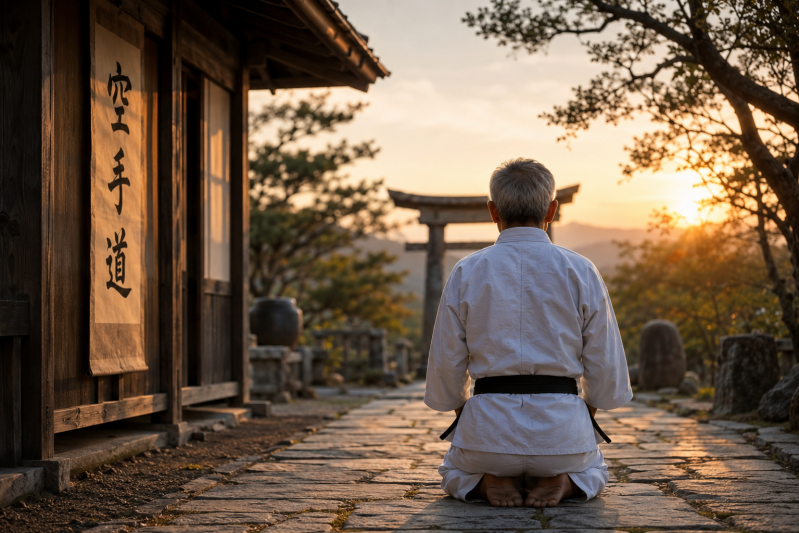
The journey toward becoming a master in martial arts is not a journey that can be measured simply by the color of a belt, the number of years spent training, or the rank written on a certificate. Those things have their place, and rank represents an important part of the traditional martial arts system, but true mastery goes much deeper. It is a journey that slowly changes the way a person thinks, trains, teaches, and lives. In the beginning, we often enter martial arts because we want to become stronger, learn how to defend ourselves, earn a black belt, or accomplish something we have never accomplished before. We look toward the next rank because it gives us something to work toward. But as the years pass, the meaning of the journey begins to change. What once seemed like the destination becomes only another step along the path.
Every martial artist begins as a student, and there is something important about that beginning that should never be forgotten. The student must learn to listen, observe, repeat, make mistakes, and try again. In those early years, we often do not understand why we are being asked to perform a movement a certain way or why our instructor insists on something that seems insignificant. We simply trust the person teaching us and trust the process. Over time, however, we begin to understand that those seemingly small details were teaching us something much greater than technique. They were teaching patience, discipline, attention, perseverance, and the ability to accept correction without allowing our pride to get in the way.
As the martial artist progresses, the questions begin to change. In the beginning, we ask, "How do I perform this technique?" Eventually, we begin asking, "Why does this technique work?" That change represents an important stage in the journey. We begin to see that kata are not simply movements that must be memorized, that stances are not merely positions we hold because our instructor told us to, and that techniques are not simply methods of defeating an opponent. There is purpose behind the movement. There is timing, distance, balance, breathing, posture, awareness, and intention. The more we study, the more we realize that martial arts is not simply about collecting techniques. It is about understanding the principles that connect them.
One of the greatest challenges along this journey is learning to control the ego. This can become particularly difficult as a martial artist gains experience and begins receiving recognition from others. Higher rank brings responsibility, but it can also bring the temptation to believe that we have somehow arrived at the top. We may begin to think that because others look to us for answers, we must have all the answers. A true master understands that this is impossible. The deeper our understanding becomes, the more clearly we see how much we still do not know. The master remains a student because there is always another detail to discover, another perspective to consider, and another lesson waiting to be learned.
Humility therefore becomes one of the defining characteristics of true mastery. Humility does not mean lacking confidence or pretending that years of training have not given you ability. It means understanding where that ability came from and recognizing the people who helped you develop it. Every master was once a beginner. Every instructor once stood in front of someone else and tried to learn. Every accomplished martial artist has had teachers, training partners, mentors, and students who contributed to his development. To forget those people is to forget part of the journey itself. The higher a martial artist climbs, the more important it becomes to remember those who helped him get there.
Trust is another important part of the journey. Early in training, we learn to trust our instructor and the traditions that have been passed down to us. Later, we learn to trust our own training. There is a difference between confidence and arrogance. Arrogance comes from needing to prove what you can do. Confidence comes from knowing that you have prepared yourself and accepting whatever happens without needing to demonstrate your superiority. A true master does not have to constantly prove that he is capable. His calmness, understanding, and control become evidence of his experience. He knows his strengths, but he also understands his limitations.
Eventually, the martial artist begins to realize that the greatest test of his training does not happen inside the dojo. It happens in everyday life. Martial arts teaches us how to respond when we are challenged, but the real question is whether we can remain calm when someone insults us, patient when someone frustrates us, disciplined when nobody is watching, and humble when we are praised. It is easy to appear disciplined while wearing a martial arts uniform and standing among other practitioners. The greater challenge is carrying those principles into our homes, our workplaces, our relationships, and our daily lives. If martial arts has truly become part of us, then its lessons should be visible even when we are not standing on the training floor.
At some point, the student also becomes responsible for teaching others. This is one of the most important transitions in the martial artist's life. Teaching is not simply demonstrating techniques or correcting someone's stance. Teaching means accepting responsibility for another person's development. Students watch their instructors much more closely than instructors sometimes realize. They observe how their teacher handles frustration, how he treats senior and junior practitioners, how he responds to mistakes, and whether he practices the principles he expects from others. A teacher cannot demand humility from his students while displaying arrogance himself. He cannot demand respect while treating others without respect. Leadership in martial arts begins with example.
This is also where the responsibility of tradition becomes important. Traditional martial arts are not simply collections of techniques created by one person. They represent generations of knowledge that have been carried forward by people who trained before us. Every kata, principle, movement, and lesson has a history. When we receive that knowledge, we become temporary custodians of something that existed before us and, if we do our job correctly, will continue after us. We do not truly own the tradition. We are responsible for protecting it, understanding it, and passing it forward.
Preserving tradition does not mean refusing to learn or refusing to think. In fact, true preservation requires understanding. It is easy to repeat something exactly as we were taught, but a deeper responsibility is to understand why it was taught that way. The martial artist must learn the difference between preserving the essence of a tradition and simply preserving its appearance. The goal should be to keep the principles alive rather than allowing them to become empty movements performed without understanding. Tradition survives when each generation learns deeply enough to appreciate what was given to them and becomes responsible enough to pass it on without allowing its meaning to disappear.
There is also a difficult moment that eventually comes in the journey of many martial artists: realizing that the people who once guided us will not always be there. Instructors grow older. Some stop training. Others become unable to continue. Some pass away. Eventually, the student who once looked toward his teacher for guidance may find himself standing in the position where others are now looking toward him. This can be humbling because we may question whether we are ready. The truth is that we may never feel completely ready. But the responsibility does not require us to become the person who came before us. It requires us to honor what they gave us, continue learning, and carry the knowledge forward with integrity.
Perhaps one of the greatest paradoxes of martial arts is that the closer someone gets to mastery, the more comfortable he becomes with being a student. After decades of training, there are still questions. A kata practiced thousands of times can reveal something new. A student can ask a question that causes the instructor to reconsider something he thought he understood. A simple movement can suddenly make sense in a way it never had before. The master does not stop learning; he simply learns to look more deeply. He understands that experience does not eliminate the need for curiosity. In many ways, experience makes curiosity more meaningful.
The true master also begins to understand that leadership is not about standing above others. It is about standing among them and helping them move forward. He does not need to constantly announce his rank or remind people of his accomplishments. His character becomes more important than his title. He listens more than he speaks. He corrects without humiliating. He teaches without making his students dependent upon him. He encourages others to become stronger than they were yesterday, not to become copies of himself. The best teacher eventually wants his students to develop beyond what he was capable of, because their success is not a threat to his legacy. It is the continuation of it.
In the end, the journey toward mastery is really a journey toward becoming a better human being. Martial arts may begin with physical movement, but its deepest lessons concern character. It teaches us to control ourselves before attempting to control anything else. It teaches us that strength without discipline can become dangerous, knowledge without humility can become arrogance, and rank without character is ultimately meaningless. The martial artist who truly understands the path begins to realize that his greatest victories are not the moments when he defeats someone else. They are the moments when he defeats his own impatience, pride, anger, fear, and doubt.
The belt will eventually become worn. Certificates will eventually fade. Titles and accomplishments will eventually become memories. What remains is the influence we had on the people who trained beside us and the people who came after us. The students we encouraged, the traditions we preserved, the lessons we passed forward, and the example we set become the real measure of what our journey meant.
A true master does not believe he has reached the end of the path. He understands that there is no final destination. Mastery is not a place where the journey ends; it is a state of mind that allows the journey to continue. It is the ability to remain humble after gaining experience, to remain trusting after experiencing disappointment, to remain disciplined when nobody is watching, and to remain a student even after others begin calling you a master.
Perhaps that is the greatest lesson of all. The master is not the person who has learned everything. The master is the person who has learned how to continue learning, how to lead without ego, how to teach without possession, and how to walk the path with gratitude for those who came before and responsibility for those who will come after.
That is the journey.
And it never truly ends.