


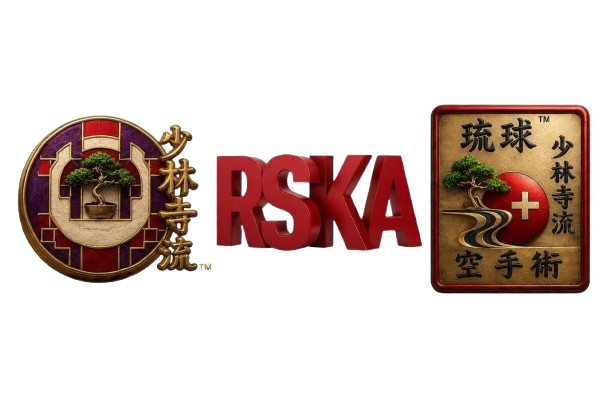

The Story Behind Our Logos
The school logos of the Ryukyu Shorinji-Ryu Karate Association trace their origins to two distinctive patches that were carefully designed, refined, and developed over time by Grandmaster Kenneth Balliet and Grandmaster Michael Davies. More than simple identifiers, these patches served as visual representations of the principles, traditions, heritage, and evolution of the martial arts they dedicated their lives to teaching.
To fully appreciate the symbolism and meaning embodied within the current school logos, it is important to understand the history and development of the original patches from which they evolved. Every element within the designs was chosen with purpose, reflecting the values of discipline, respect, perseverance, and the enduring spirit of traditional Okinawan martial arts. The patches also honor the contributions and vision of the individuals who shaped and preserved the system throughout its growth.
Our journey begins with the original Ryukyu Shorinji Ryu Karate Jutsu patch, the emblem that represented Grandmaster Kenneth Balliet and the schools operating under his leadership. As the organization evolved, so too did the patch, transforming into a powerful symbol of lineage, tradition, and the continuous pursuit of improvement that defines the martial arts path. Today, its legacy remains woven into the identity of the Ryukyu Shorinji Ryu Karate Association and the school logos that carry its spirit forward.
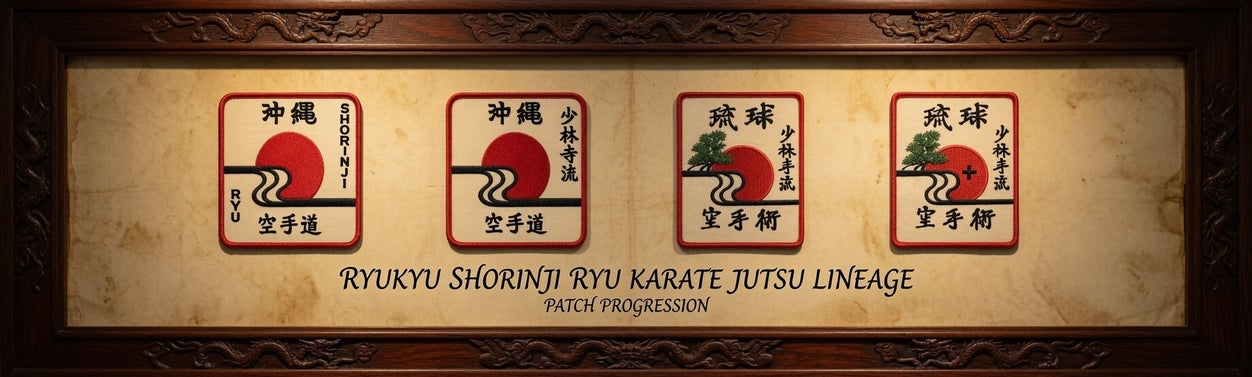
Ryukyu Shorinji-Ryu Karate Jutsu Original School Patch
The precise origin of the original school patch remains uncertain; however, its earliest known association is with Grandmaster Michael Broadman. A practitioner of Shorinji Ryu, Broadman trained under Grandmaster Zenpo Shimabukuro, who introduced and taught the system during his visit to Philadelphia, Pennsylvania, in September 1963. The original patch incorporated both English and Japanese text. The kanji used at that time translated as 沖縄 (Okinawa) and 空手道 (Karate-dō), meaning “The Way of the Empty Hand.”
Throughout its history, the patch has undergone a series of deliberate modifications reflecting both the evolution of the art and the individuals who carried its traditions forward. One of the earliest changes involved replacing the English inscription “Shorinji Ryu” with traditional Japanese kanji, bringing the design into closer alignment with the Okinawan heritage and cultural origins of the style.
As the system continued to develop, Grandmaster Kenneth Balliet adopted and adapted his instructor’s patch following the establishment of his own school. After his promotion to the rank of 10th Dan in Shorinji Ryu, Grandmaster Balliet further revised the design to more accurately represent the style being taught. The original inscription identifying the art as “Okinawa Shorinji Ryu Karate-Do” was replaced with “Ryukyu Shorinji Ryu Karate-Jutsu,” emphasizing both the Ryukyuan roots of the system and its traditional martial application.
In time, Grandmaster Balliet introduced the image of a bonsai tree into the design. The bonsai was chosen as a symbol of patience, disciplined growth, perseverance, and the careful cultivation of both character and technique. Later, a cross was incorporated into the emblem, reflecting his personal Christian faith and further distinguishing the patch as a unique representation of his lineage and teachings.
Today, the patch continues to undergo subtle refinements while preserving its essential identity and symbolism. Its evolution reflects the philosophy that Shorinji Ryu is not a static tradition but a living martial art—one that honors its heritage while adapting through the experiences and contributions of each generation. Practitioners are encouraged not only to preserve the teachings they receive but also to internalize, refine, and embody them in their own development. In this way, the art continues to grow organically while remaining firmly rooted in its historical foundations.
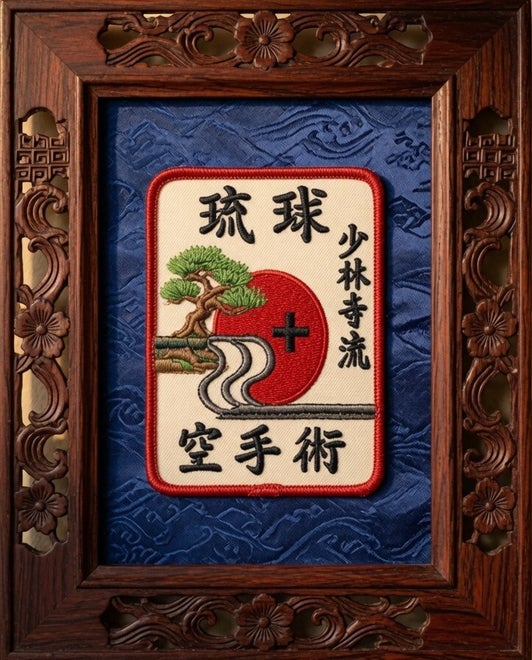
Ryukyu Shorinji-Ryu Karate Association – Black Belt Patch
Granted to black belt members committed to the authentic path and teachings of Grandmaster Kenneth Balliet and the Ryukyu Shorinji-Ryu Karate Jutsu tradition.
Interpretation of the Ryukyu Shorinji-Ryu Karate Jutsu Patch
The Ryukyu Shorinji-Ryu Karate Associations offers the following interpretation of the patch and its symbolism:
The beginning black line signifies the influence of martial arts flowing into Okinawa from neighboring regions and cultures. As this line enters the red circle, representing the Okinawan flag and the Kingdom of Ryukyu, it divides into three separate streams symbolizing the three original branches of Okinawan karate: Shuri-te, Naha-te, and Tomari-te. These systems were named after the towns in which they developed—Shuri, Naha, and Tomari—and each contributed unique principles and training methods to the evolution of Okinawan martial arts.
The downward movement of these three streams resembles a waterfall, symbolizing purification, continuity, and the disciplined refinement of these foundational traditions through generations of dedicated practitioners. As the streams reunite into a single black line, they represent the convergence of these influences and their collective contribution to the development of the Ryukyu Shorinji Ryu system.
The bonsai tree symbolizes the growth and evolution of Shorinji-Ryu into Ryukyu Shorinji-Ryu Karate Jutsu. Its roots represent the additional knowledge, experience, and influence gained from other martial artists and systems that contributed to the continued development of the art. Deeply rooted yet carefully cultivated, the bonsai serves as a symbol of tradition, patience, perseverance, and the intentional development of character. Its carefully shaped form reflects the lifelong process of refining both technique and spirit through discipline, humility, and dedication.
Taken together, these elements embody the core values of Ryukyu Shorinji-Ryu Karate Jutsu: respect for lineage, commitment to disciplined training, continuous personal growth, and the preservation of traditional martial arts principles for future generations.
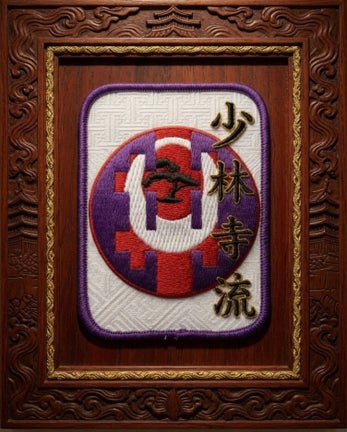

Ryukyu Shorinji-Ryu Karate Association – School Patch
History and Meaning of the Revised School Patch
The development of the revised patch was undertaken with the guidance and input of two senior instructors and longtime family friends, Hanshi Therold Davenport and Hanshi Michael Davies, both of whom were in the process of establishing their own independent schools. Their contributions were instrumental in ensuring that the redesigned emblem more accurately reflected the historical origins of the Ryukyu Shorinji-Ryu Karate Jutsu system and its lineage tracing back to Chotoku Kyan.
The foundation of the patch design is based upon the Okinawan flag and the former Kingdom of Ryukyu, symbolizing the birthplace of Okinawan karate and the three original branches from which the art developed: Shuri-te, Naha-te, and Tomari-te. These traditions form the historical roots from which modern Okinawan karate systems evolved.
At the center of the design is the bonsai tree, representing the lasting influence of Grandmaster Kenneth Balliet and the growth of the Ryukyu Shorinji-Ryu Karate Jutsu system under his guidance. Like a bonsai tree that is carefully cultivated over generations, the art has been preserved, nurtured, and passed forward through dedicated instructors and students.
The Kyan family crest has been divided symmetrically and positioned over the Okinawan flag. This element symbolizes the origins and foundational roots of the system while honoring the direct influence of Master Chotoku Kyan. It also represents the preservation of the original kata and teachings that continue to be practiced within the system today.
While the original patch remains the official emblem of the Ryukyu Shorinji-Ryu Karate Jutsu Black Belt Club, preserving its historical and organizational significance, the revised patch was created to represent the individual school and its unique connection to the lineage. The design serves as a visual reminder of the unbroken chain of instruction, tradition, and knowledge passed from generation to generation, reinforcing both the school's identity and its historical foundation within the teachings of Chotoku Kyan.
Through its symbols and design elements, the patch stands as a tribute to the heritage of Okinawan karate, the legacy of Grandmaster Kenneth Balliet, and the continued commitment to preserving the traditions and principles of Ryukyu Shorinji-Ryu Karate Jutsu for future generations.
"Our school patch is more than just an emblem; it is a constant reminder of the dedication, tradition, and community we build together at the Ryukyu Shorinji Ryu Karate Association."
Head Instructor Michael Davies