

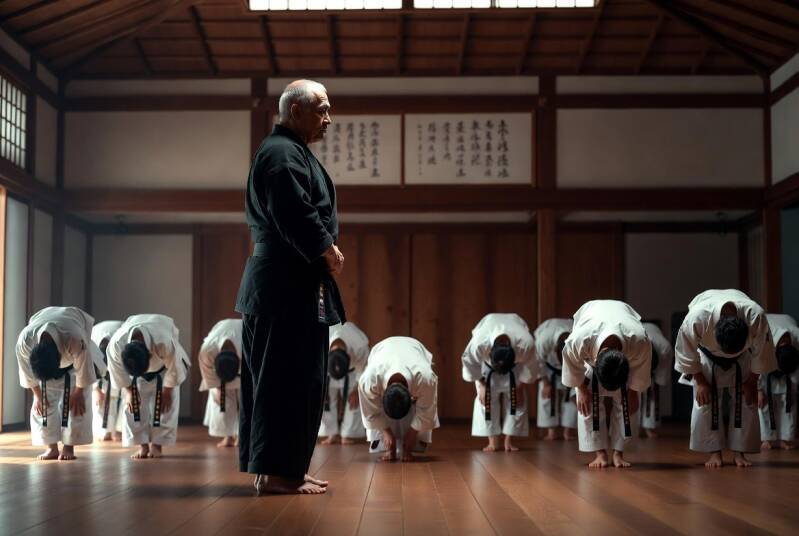
If you’ve trained in a karate dojo, you’ve likely bowed and addressed your instructor as Sensei. As you progress, you might hear whispers of Shihan, Renshi, Kyoshi, or the lofty Hanshi. These aren’t just fancy labels—they represent years of dedication, teaching excellence, and contribution to the art.
Unlike belt ranks (which mark technical progress), karate titles are honorifics and teaching licenses that recognize leadership and character. Here’s the full story: where they came from, when they were introduced, and when they’re typically issued today.
The Historical Roots: From Okinawa to Organized Japan
Traditional Okinawan karate had no formal titles or colored belts. Instructors were respected elders, often addressed simply by name or with basic honorifics. “Sensei” (先生) — meaning “one who came before” or “born earlier” — was already in common use as a general term of respect for teachers.
Everything changed in the 1920s when Gichin Funakoshi and other pioneers introduced karate to mainland Japan. To gain legitimacy alongside established arts like Judo and Kendo, they adopted Japanese martial traditions. The Dai Nippon Butoku-kai (Japan’s national martial arts body) played a major role in formalizing ranks and titles in the early-to-mid 20th century.
Post-World War II, as karate spread globally through organizations like the JKA (Japan Karate Association) and later the WKF, these titles became more standardized. They evolved from simple respect into structured teaching licenses that emphasize responsibility to preserve and pass on the art.
The Most Common Karate Titles: Meaning and Timeline
Here’s a breakdown of the major titles you’ll encounter:
- Sensei Meaning: Teacher or instructor. Introduced: Long before modern karate — used in Okinawa and adopted widely in the 1920s–1930s. When issued: Typically when a practitioner begins teaching, often at 1st to 3rd Dan (Shodan to Sandan). In many modern dojos, a new black belt helping with classes may be called Sensei out of respect. Traditional schools may wait until 3rd Dan or higher.
- Senpai Meaning: Senior student or assistant. Introduced: Early 20th century with structured dojo training. When issued: Advanced kyu ranks or early dan. Not a formal instructor title.
- Shihan (師範) Meaning: Master instructor or head of a branch/style. Introduced: Mid-20th century as karate professionalized. When issued: Usually 4th to 6th Dan and above, after proving leadership and producing quality students. This is a significant milestone.
- Renshi (“Polished Expert Instructor”) Meaning: Recognized teacher with refined skills. Introduced: Formalized in the 1950s–1960s by major organizations. When issued: Often 5th or 6th Dan. The first of the higher “Shi” teaching licenses. Requires demonstrated teaching ability.
- Kyoshi (“Teacher of Teachers”) Meaning: Advanced instructor who trains other instructors. Introduced: Mid-20th century. When issued: Typically 6th to 8th Dan. Involves significant time, often with panel reviews or contributions to the style.
- Hanshi (“Model Master” or Grandmaster) Meaning: The highest honorary title — a living example of the art. Introduced: Mid-20th century. When issued: 8th to 10th Dan, extremely selective. Lifetime achievement award for character, influence, and decades of service. Very few people ever receive it.
How Titles Are Awarded Today
Most titles above Sensei require:
- A minimum dan rank and years “in grade.”
- Recommendation from a higher-ranked master or organizational board.
- Evidence of teaching, seminars, competition success, or stylistic contributions.
- In some cases, written theses, demonstrations, or peer review.
There is no universal standard — each style (Shotokan, Goju-ryu, Shito-ryu, etc.) and organization sets its own rules. Western dojos sometimes use titles more generously for motivation, while traditional Japanese and Okinawan lineages tend to be more conservative.
Why These Titles Still Matter
In karate’s budo philosophy, titles are not about ego. They represent duty: the responsibility to teach correctly, uphold standards, and guide the next generation with humility. A true Hanshi isn’t just skilled — they embody the spirit of the art.
As the old saying goes, the belt may hold up your pants, but the title reflects the weight of knowledge and leadership you carry.