

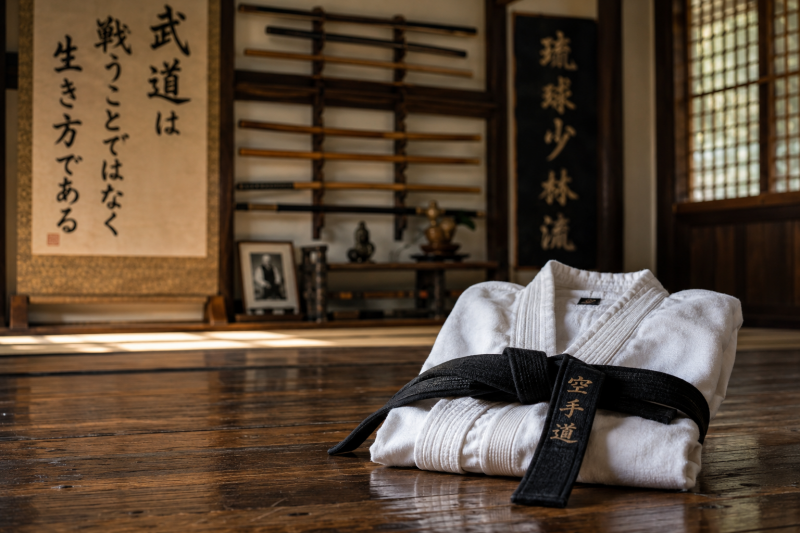
How the evolution from survival skills to the "Way" changed martial arts—and why understanding the difference still matters today.
By the Ryukyu Shorinji Ryu Karate Association
Every martial artist eventually encounters two words:
Jutsu.
Do.
They appear in the names of many familiar martial arts—Karatedo, Judo, Kendo, Aikido, and others.
But these words represent more than different ways of spelling a martial art.
They represent a fundamental change in why martial arts were practiced.
Jutsu refers broadly to an art, technique, or method—the practical application of a skill.
Do means "the Way."
One is concerned heavily with what you can do.
The other asks what kind of person you become through the journey.
Understanding how martial arts moved from Jutsu toward Do helps explain both the incredible growth of martial arts around the world and some of the problems that exist within modern training.
More importantly, it raises a question worth asking:
Have we preserved the martial art—or only the appearance of one?
When Martial Arts Were About Survival
Long before karate tournaments, belt rankings, trophies, and martial arts schools existed on every corner, martial skills were developed for a very different world.
In feudal Japan, disciplines such as Kenjutsu, Kyujutsu, and Jujutsu existed within societies where martial ability could have very real consequences.
A technique was not valuable because it looked impressive.
It was valuable because it worked.
The opponent did not cooperate.
There was no referee.
There were no rounds.
There were no points.
There were no weight classes.
And there was certainly no guarantee that the encounter would stop when someone tapped out.
The practitioner had to deal with resistance, unpredictability, fear, exhaustion, and consequences.
Failure could be serious.
This created something that modern martial artists sometimes struggle to reproduce:
Reality provided the test.
Then the Battlefield Disappeared
Society changed.
The Meiji Restoration of 1868 transformed Japan, and the traditional warrior class lost its former role. Modern military forces replaced the old battlefield structure, and traditional martial schools suddenly faced a serious problem.
What purpose did an old martial system have in a rapidly modernizing society?
If martial arts remained solely battlefield skills, they risked disappearing altogether.
So martial arts evolved.
And that evolution changed everything.
From Jutsu to Do
Rather than allowing martial traditions to disappear, teachers began finding ways to preserve them through education, physical development, and personal discipline.
One of the most influential examples was Jigoro Kano, who developed Judo from older jujutsu traditions.
Kano understood that martial arts could become more than methods for defeating an opponent.
They could become methods for developing the individual.
Training could teach:
Discipline.
Perseverance.
Respect.
Self-control.
Physical fitness.
Mental development.
Responsibility.
The martial art became a Way.
This transformation allowed martial arts to survive and eventually reach millions of people.
It was not necessarily the death of martial arts.
In many ways, it was their rebirth.
The Problem Isn't Do
It is tempting to look at history and say:
Jutsu was real. Do ruined martial arts.
The reality is far more complicated.
Do preserved martial traditions that might otherwise have disappeared.
It made training safer.
It allowed martial arts to be taught to children and ordinary members of society.
It turned martial arts into a vehicle for education and personal development.
Those are accomplishments worth preserving.
The problem begins when the Way becomes completely disconnected from the martial substance underneath it.
A martial artist should not have to choose between practical ability and personal development.
They should develop both.
Jutsu without discipline can create recklessness.
Do without martial substance can create illusion.
The goal should be integration.
When Sport Becomes the Reality
Modern martial sport has tremendous value.
Competition teaches people how to deal with pressure.
It develops timing, athleticism, courage, perseverance, humility, and discipline.
There is nothing inherently wrong with sport.
The problem occurs when we forget that sport is a controlled environment created by rules.
A competition asks:
How do I defeat my opponent within these rules?
Real-life violence asks entirely different questions:
Can I recognize danger?
Can I avoid it?
Can I protect someone?
Can I escape?
Can I remain calm?
Can I make a good decision under extreme pressure?
There may be no referee.
There may be no agreed rules.
There may be no protective equipment.
There may be no second opportunity.
That does not make sport worthless.
It simply means sport and self-defense are not the same thing.
The Most Important Skill May Be Not Fighting
This is where traditional martial discipline becomes especially important.
The purpose of martial arts should not be to create people who are constantly looking for an opportunity to fight.
It should create people who have enough confidence and self-control that they do not need to.
A martial artist should learn to recognize danger before it becomes unavoidable.
They should understand when to disengage.
They should control anger rather than allowing anger to control them.
They should understand the consequences of violence.
And when avoidance is no longer possible, they should possess the ability to protect themselves or others.
Capability should produce restraint.
Not aggression.
Not arrogance.
Not a constant need to prove superiority.
The person who has nothing to prove may actually be the person who has developed the greatest understanding of martial arts.
The Problem of Compliant Training
Another consequence of removing martial arts from their original environment is the possibility of becoming too comfortable with cooperation.
A student performs a technique.
A partner gives the expected reaction.
The sequence is repeated.
Eventually, the student becomes very good at performing that sequence.
But what happens when the other person doesn't cooperate?
They resist.
They move.
They change direction.
They panic.
They attack unexpectedly.
They adapt.
Suddenly, the perfect technique doesn't look so perfect.
This is why responsible martial training needs some form of pressure testing.
That doesn't mean every class needs to become a fight.
It means the practitioner must occasionally experience resistance and uncertainty.
Otherwise, there is a danger of becoming highly skilled at performing martial arts while never discovering whether those skills actually hold up under pressure.
Kata Still Matters
This is also why we should be careful about dismissing traditional kata.
Kata is sometimes criticized because it does not resemble a modern sporting match.
But kata was never intended to be simply a miniature competition.
Kata can preserve:
- Body mechanics
- Balance
- Timing
- Breathing
- Movement patterns
- Principles
- Transitions
- Tactical concepts
- Historical knowledge
The problem isn't kata.
The problem is performing kata without understanding it.
A movement can be beautiful and still have practical meaning.
A traditional form can preserve history while also teaching application.
The martial artist's responsibility is to look deeper than the performance.
When the Belt Becomes the Product
There is another transformation worth discussing.
As martial arts became popular, they also became businesses.
That isn't automatically a bad thing.
Schools require facilities.
Instructors need to make a living.
Equipment costs money.
Organizations need resources.
But commercialization creates a temptation.
The belt can become more important than the knowledge.
The trophy can become more important than the training.
Rank can become a product.
Testing can become a transaction.
Marketing can become more important than substance.
This is where the idea of the "McDojo" comes from.
The problem isn't that someone operates a martial arts business.
The problem is when the business model begins determining what the martial art becomes.
A belt should represent development.
A rank should represent responsibility.
A title should represent experience and accountability.
They should never become merely things that can be purchased.
Pressure Testing Doesn't Mean Abandoning Tradition
Modern combat sports and mixed martial arts provided an important reality check for martial arts worldwide.
When different systems were placed into environments where participants resisted one another, practitioners learned quickly which ideas were reliable under pressure and which needed reconsideration.
That lesson should not frighten traditional martial artists.
It should encourage them.
Pressure testing is not an enemy of tradition.
It can be a way of protecting tradition from fantasy.
It forces us to ask:
Does this movement have a purpose?
Do I understand how it works?
Can I perform it under pressure?
What happens when my opponent does something unexpected?
These are healthy questions.
Jutsu and Do Belong Together
Perhaps the greatest mistake is believing that we have to choose.
We don't.
Jutsu gives us capability.
Do gives us direction.
Jutsu asks:
Can you do it?
Do asks:
What will you do with that ability?
One develops the tool.
The other develops the person holding it.
A martial artist should train seriously enough to understand resistance, pressure, timing, distance, movement, and application.
But that same martial artist should develop enough discipline to understand that physical ability carries responsibility.
Training for a World Without Rules
There is a profound difference between training within rules and believing that the rules are reality.
Rules are valuable.
They make training safer.
They create structure.
They allow people to test themselves.
They protect training partners.
But outside the dojo, life does not promise those boundaries.
The purpose of martial training should therefore be bigger than winning a match.
It should develop qualities that remain useful when the match is over.
Awareness when there is no referee.
Composure when there is no time limit.
Judgment when there are no points.
Restraint when anger would be easier.
Courage when walking away is no longer possible.
Responsibility when the consequences are real.
That is when martial arts become a discipline for life.
From Fighting to Self-Mastery
The evolution from Jutsu to Do should not simply be viewed as the death of authentic martial arts.
It can be viewed as a challenge.
The old systems were created in a world where survival demanded martial ability.
The modern Do traditions showed how that ability could become a lifelong path of personal development.
We need both lessons.
Train hard.
Understand the application.
Pressure-test your assumptions.
Respect tradition.
Question what does not make sense.
Develop physical capability.
Develop mental discipline.
And most importantly, develop the self-control necessary to know when not to use that capability.
Because the ultimate measure of a martial artist is not how many people they can defeat.
It is not how many trophies they have won.
It is not how many belts they possess.
And it is not how intimidating they appear.
The deeper measure is whether training has made them:
More capable.
More disciplined.
More aware.
More responsible.
The Way Forward
Traditional martial arts do not need to return to the battlefield.
They need to return to purpose.
Train for reality without glorifying violence.
Preserve tradition without becoming trapped by it.
Use sport as a training tool without allowing sport to define the entire art.
Practice kata without losing application.
Develop fighting ability without developing a desire to fight.
Pursue the Do without forgetting the Jutsu that gave the Way its foundation.
The battlefield may be gone.
The need for self-control is not.
The need for discipline is not.
The need to protect ourselves and those around us is not.
And the need to develop people who can remain calm, responsible, and capable when life becomes difficult is certainly not.
Jutsu taught us how to survive conflict.
Do challenges us to master ourselves.
The martial artist's responsibility is to understand both.
RSKA Perspective
At the Ryukyu Shorinji Ryu Karate Association, we believe traditional martial arts should remain connected to their purpose.
Karate should be more than a collection of movements.
It should be more than competition.
It should be more than rank.
And it should be more than the appearance of being a martial artist.
It should be a lifelong discipline that develops capability, self-control, respect, responsibility, and leadership.
The goal is not to teach people to seek conflict.
The goal is to prepare them for life when conflict, hardship, or adversity cannot simply be avoided.
Train seriously.
Live responsibly.
Preserve the tradition.
Master yourself.
That is the Way.