

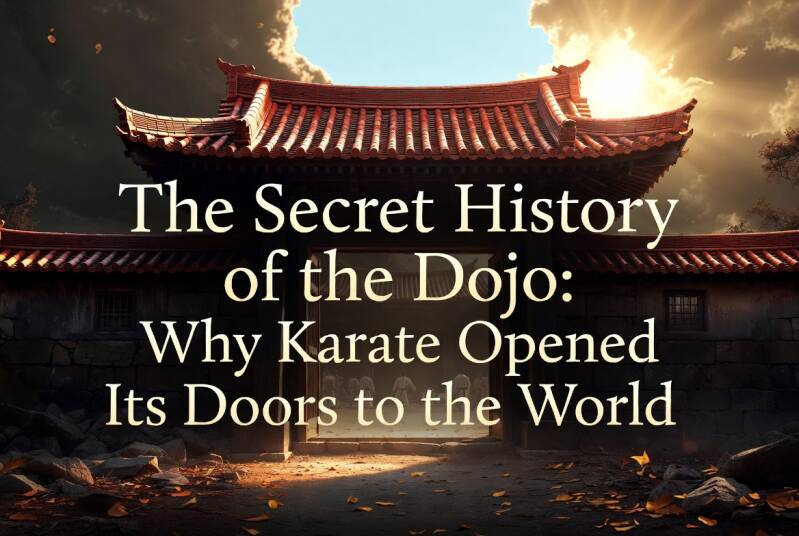
The Post-War Pivot: How Resilience Saved the Soul of Authentic Okinawan Karate
Walk into any modern dojo today, and the scene is instantly familiar: neat rows of students in crisp white uniforms, colored belts symbolizing progress, and a structured curriculum.
But if you could travel back in time to 19th-century Okinawa, you wouldn't recognize the art at all.
Before it became an accessible global practice, karate was a hidden, lethal combat system passed down in absolute secrecy. How did it transform from a closely guarded island secret into an international vehicle for personal growth?
The answer lies in a fascinating story of post-World War II resilience, adaptation, and economic survival.
The Secret Era: Closed Doors and Practical Combat
For generations, Okinawan martial arts (originally known as Te or Todi) were not a business. They were a survival tool.
Practiced primarily by the island's elite security class and specialized families, lessons took place under the cover of night in private gardens. There were no commercial schools, no public rank advancement systems, and no sports tournaments.
The training was brutal, practical, and designed entirely for self-defense. Masters only taught a select few students whom they trusted implicitly. Had history stayed on this track, many of these classical traditions would have died out alongside the final generation of those old-world masters.
The Catalyst: Rebuilding After the Devastation of WWII
The turning point arrived in 1945. The Battle of Okinawa left the island utterly devastated. Infrastructure was flattened, families were displaced, and the local economy was virtually non-existent.
In the bleak aftermath of the war, legendary martial arts masters faced a harsh reality: they needed a way to feed their families and rebuild their communities.
At the same time, a massive influx of American military personnel stationed on the island noticed the incredible skill and focus of the local practitioners. The servicemen wanted to learn, and the Okinawan masters possessed a deeply valuable, life-changing skill.
Out of sheer economic necessity, the doors to karate were thrown open to the Western world.
Redesigning the Art for Global Preservation
To transition from a private combat system to a structured school model, Okinawan masters had to reinvent how the art was organized. They couldn't teach lethal, unregulated battlefield tactics to hundreds of rotating foreign soldiers safely.
To scale their teachings, they implemented several brilliant innovations that revolutionized the martial arts world:
- The Rank System: Masters formalized the colored belt system. This gave modern students clear, motivating milestones to track their progress.
- The Uniform: The standard white gi was widely adopted to establish a sense of equality, shared discipline, and mutual respect on the mat.
- The Shift to Self-Realization: The ultimate goal shifted toward character building, mental focus, and personal growth.
By opening their doors, these masters didn't dilute their knowledge—they saved it. They ensured that classical forms and concepts would be preserved by anchoring them to a sustainable, modern educational model.
Honoring the Lineage at the Ryukyu Shorinji-Ryu Karate Association
This history directly shapes how we train today. Every time a student bows onto the mat, they are participating in a living legacy born from Okinawan resilience.
At the Ryukyu Shorinji-Ryu Karate Association, our mission is to preserve, promote, and carry forward the deep, traditional roots of Ryukyu Shorinji-Ryu Karate-Jutsu. We proudly carry on the teachings and legacy of Hanshi Kenneth Balliet, honoring a system rooted in classical Okinawan principles.
Commercialization allowed karate to travel across oceans; our duty is to ensure that its true spirit of discipline, honor, and authentic self-defense continues to thrive right here in Williamsport.