

The story behind our symbol
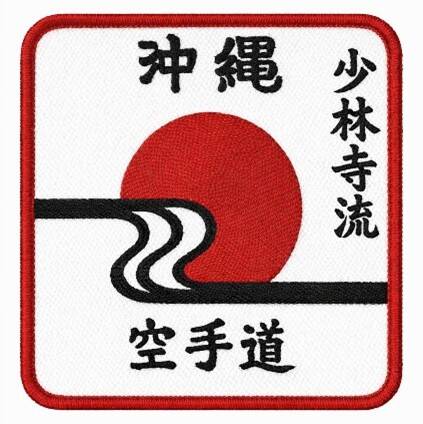
The precise origin of the patch remains uncertain; however, it is most closely associated with its early use by Grandmaster Michael Broadman. A practitioner of Shorinji Ryu, Broadman trained under Grandmaster Zenpo Shimabukuro, who introduced and conducted instruction in the system during his visit to Philadelphia, United States, in September 1963.
Over the course of its development, the patch has undergone a series of deliberate modifications. One of the earliest changes involved the replacement of the English inscription “Shorinji Ryu” with traditional kanji, thereby aligning the design more closely with the Okinawan heritage and cultural origins of the style. Subsequently, Grandmaster Kenneth Balliet adopted and adapted his instructor’s patch upon the establishment of his own school.
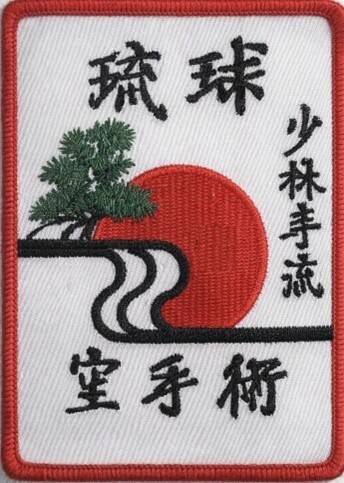
Following his promotion to the rank of 10th Dan in Shorinji Ryu, Grandmaster Balliet introduced the image of a bonsai tree into the design. This addition was intended to symbolize the principles of patience, disciplined growth, and the careful cultivation of both character and technique. In later years, a cross was incorporated, reflecting his personal religious convictions and further individualizing the emblem. Each of these modifications represents both personal expression and the broader evolution of the art.
In its present form, the patch continues to undergo subtle refinements, embodying the principle that Shorinji Ryu is not a static tradition but a dynamic and living discipline. Practitioners are encouraged not only to preserve the teachings they receive but also to internalize and adapt them in a manner that reflects their own development. In this way, the art continues to evolve organically across generations.
The Ryukyu Shorinji Ryu Karate Association offers the following interpretation of the patch
The descending lines represent the three principal Okinawan martial traditions—Shuri-te, Naha-te, and Tomari-te—converging into a unified system. Their downward flow, reminiscent of a waterfall, signifies purification, continuity, and the disciplined refinement of the human spirit. Beneath these lines stands the bonsai tree, a symbol of deep-rooted tradition, patience, and the intentional cultivation of character. Its carefully shaped form reflects the lifelong process of refining both technique and spirit with precision, discipline, and humility.
Taken together, these elements convey the essential values of lineage, discipline, and continuous personal growth that define the art of Shorinji Ryu.


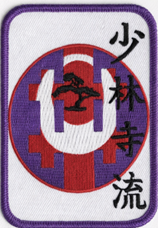
The development of the revised patch was undertaken with the guidance and input of two senior instructors and longtime family associates, Hanshi Therold Davenport and Kyoshi Michael Davies, both of whom were in the process of establishing their own independent schools. Their contributions were instrumental in ensuring that the redesigned emblem more explicitly reflected the historical origins of the Shorinji Ryu system, tracing its lineage to Master Chotoku Kyan.
Central to the updated design is a modified representation of the Kyan family crest, which has been superimposed over the Okinawan flag and accompanied by the bonsai tree. This composition serves as a symbolic narrative of transmission, representing the geographic and generational journey of the art from Master Chotoku Kyan through successive instructors to Hanshi Kenneth Balliet. The integration of these elements emphasizes both heritage and continuity within the system.
While the original patch will remain in use as the official emblem of the Ryukyu Shorinji Ryu Karate Association, preserving its historical and organizational significance, the revised patch is intended to represent the individual school and its direct lineage. In particular, it highlights the unbroken connection of instruction and tradition extending back to Master Chotoku Kyan, thereby reinforcing both identity and historical grounding.
"Our school patch is more than just an emblem; it is a constant reminder of the dedication, tradition, and community we build together at the Ryukyu Shorinji Ryu Karate Association."
Head Instructor Michael Davies