

Build Your Dojo. Preserve the Tradition.
A formal pathway for experienced martial artists and instructors committed to preserving traditional Okinawan karate through discipline, lineage, standards, mentorship, and leadership.
The RSKA School Charter Program is designed for qualified black belts and established instructors who want to build or operate a school while maintaining the traditions, technical standards, values, and lineage represented by the Ryukyu Shorinji-Ryu Karate Association.
Charter Membership
An RSKA Charter represents more than the use of a name. It represents a commitment to the preservation, practice, teaching, and responsible transmission of traditional Okinawan karate.
Building the Future of Traditional Okinawan Karate
The purpose of the School Charter Program is to establish a network of qualified schools and instructors who share the RSKA commitment to traditional training, authentic lineage, proper conduct, technical development, student safety, and lifelong martial arts growth.
Preserve the Art
Charter Schools help preserve traditional Okinawan karate by maintaining proper curriculum, training standards, lineage, etiquette, and the values that have been passed from teacher to student.
Practice With Purpose
RSKA training emphasizes discipline, respect, strength, leadership, character, technical development, and continued personal growth rather than competition or commercialism.
Lead by Example
Charter instructors are expected to lead their students through conduct, knowledge, humility, professionalism, dedication, and respect for the traditions they have been entrusted to carry forward.
Charter Requirements
Each Chartered School is expected to uphold the following standards. These requirements are intended to protect the integrity of the RSKA and the traditions represented by its schools and instructors.
01 — Rank, Experience & Technical Qualification
Rank, Experience & Technical Qualification
The individual seeking Charter recognition must possess an appropriate level of martial arts experience and technical proficiency to responsibly operate an RSKA Chartered School.
Charter applicants should demonstrate meaningful experience in traditional Okinawan karate and possess the technical knowledge necessary to teach students safely and correctly.
02 — Lineage & Rank Verification
Lineage & Rank Verification
RSKA Charter applicants may be required to provide documentation or other evidence supporting their martial arts lineage, rank, instructor history, and training background.
The RSKA reserves the right to verify rank and lineage before granting or maintaining Charter recognition.
03 — Instructor Qualification
Instructor Qualification
The principal instructor of a Chartered School must demonstrate the knowledge, maturity, technical ability, leadership, and teaching responsibility required to represent the RSKA.
Instructors are expected to understand not only the physical techniques of karate, but also the etiquette, traditions, philosophy, and responsibilities associated with teaching.
04 — RSKA Curriculum
RSKA Curriculum
Chartered Schools are expected to teach and maintain the curriculum established or recognized by the RSKA.
Training should include appropriate kihon, kata, bunkai, kumite where applicable, conditioning, etiquette, terminology, and traditional training principles.
The purpose of curriculum standards is consistency, preservation, and responsible transmission of the art.
05 — Traditional Values
Traditional Values
Chartered Schools must operate in a manner consistent with the traditional values of Okinawan martial arts.
- Discipline
- Respect
- Strength
- Leadership
- Tradition
- Humility
- Personal responsibility
- Commitment to lifelong learning
06 — Character & Professional Conduct
Character & Professional Conduct
RSKA instructors are representatives of the Association and are expected to conduct themselves professionally both inside and outside the dojo.
Instructors must demonstrate honesty, respect, responsibility, appropriate leadership, and conduct consistent with the reputation of the RSKA.
07 — Dojo Requirements
Dojo Requirements
A Chartered School must provide an appropriate training environment suitable for the instruction of traditional martial arts.
The training environment should be clean, organized, safe, properly maintained, and appropriate for the age and experience of the students being taught.
08 — Student Safety & Responsibility
Student Safety & Responsibility
Student safety is a fundamental responsibility of every RSKA instructor and Chartered School.
- Maintain a safe training environment
- Use appropriate training methods
- Provide appropriate supervision
- Respect student limitations
- Maintain appropriate emergency procedures
- Follow applicable laws and regulations
09 — Student Rank & Records
Student Rank & Records
Chartered Schools are responsible for maintaining accurate student records and ensuring that promotions and certifications are handled according to applicable RSKA standards.
Rank should be awarded based upon demonstrated knowledge, technical ability, training, conduct, and readiness rather than simply time served.
10 — Use of the RSKA Name & Emblem
Use of the RSKA Name & Emblem
The RSKA name, marks, emblems, certificates, insignia, and other Association identifiers may only be used in accordance with RSKA authorization and standards.
Charter recognition does not grant unrestricted rights to reproduce or modify official RSKA materials.
11 — Association Participation
Association Participation
Chartered Schools are encouraged to maintain an active relationship with the RSKA and participate in Association activities, training opportunities, instructor development, meetings, and other programs when appropriate.
Continued communication helps maintain consistency between Chartered Schools and the Association.
12 — Charter Application Process
Charter Application Process
Charter recognition follows an application and review process designed to determine whether the applicant and school are prepared to represent the RSKA.
Initial Inquiry
Contact the RSKA to express interest in becoming a Chartered School.
Application
Submit the information and documentation requested by the RSKA.
Background & Lineage Review
The applicant's experience, rank, lineage, teaching history, and qualifications may be reviewed.
Technical Review
The RSKA may evaluate technical proficiency and understanding of the required curriculum.
School Review
The proposed school, training environment, student structure, and operational standards may be reviewed.
Approval
Charter recognition is granted only after the appropriate RSKA review and approval process has been completed.
Charter Recognition
The approved school receives recognition as an RSKA Chartered School and agrees to maintain the applicable Association standards.
13 — Maintaining Charter Status
Maintaining Charter Status
Charter recognition is an ongoing responsibility. Schools are expected to continue meeting RSKA standards after initial approval.
- Maintain qualified instruction
- Maintain appropriate training standards
- Maintain student records
- Maintain appropriate conduct
- Maintain proper use of RSKA branding
- Remain in good standing with the Association
- Continue supporting traditional Okinawan karate
14 — Suspension or Revocation
Suspension or Revocation
The RSKA reserves the right to suspend or revoke Charter recognition when a school or instructor fails to maintain applicable standards or acts in a manner inconsistent with the mission and values of the Association.
Circumstances may include serious misconduct, misuse of the RSKA name or emblem, unsafe practices, misrepresentation of rank or lineage, or continued failure to meet Charter requirements.
15 — What an RSKA Charter Represents
What an RSKA Charter Represents
An RSKA Charter represents a commitment to preserving traditional Okinawan karate while providing students with a structured path for technical development, personal growth, leadership, and lifelong study.
A Charter is not simply a business affiliation. It represents responsibility to the art, to the instructor's teachers, to the students, and to the lineage that came before.
Charter recognition carries both privilege and responsibility.
16 — Black Belt Club Selection
Black Belt Club Selection
Qualified instructors affiliated with an RSKA Chartered School who hold black belt rank and are 18 years of age or older may be considered for selection to the RSKA Black Belt Club.
Black Belt Club selection is not automatic. Membership is a recognition of an instructor's continued commitment to the RSKA, traditional Okinawan karate, leadership, character, technical development, and preservation of the Association's lineage and standards.
In considering an instructor for Black Belt Club selection, the RSKA may consider the following:
- Being 18 years of age or older
- Holding a recognized black belt rank
- Serving as an instructor affiliated with an RSKA Chartered School
- Maintaining good standing with the RSKA
- Demonstrating appropriate technical knowledge and teaching ability
- Demonstrating character, discipline, leadership, and respect
- Demonstrating commitment to traditional Okinawan karate
- Respecting and preserving RSKA lineage, traditions, and standards
- Receiving selection or approval by the appropriate RSKA authority
Black Belt Club selection is a privilege and recognition. It is not an automatic benefit of Charter School affiliation and does not, by itself, confer additional rank, instructor certification, or instructor authority unless separately granted by the RSKA.
Charter Opportunities
RSKA Charter recognition is intended to provide qualified instructors with a stronger connection to the Association while supporting the continued growth and preservation of traditional Okinawan karate.
Instructor Development
Continue developing technical knowledge, teaching ability, leadership skills, and understanding of traditional Okinawan karate through continued study and Association connection.
Association Connection
Maintain a direct relationship with the RSKA and participate in appropriate Association training, programs, instructor development, and organizational activities.
School Development
Build a school based upon traditional standards while receiving the structure and support necessary to develop students, instructors, leadership, and the future of the dojo.
Black Belt Club Selection
Qualified black belt instructors who are 18 years of age or older and affiliated with an RSKA Chartered School may be considered for selection to the RSKA Black Belt Club. Selection is not automatic and is based upon the instructor's qualifications, character, leadership, technical development, teaching ability, commitment to traditional Okinawan karate, and adherence to RSKA standards.
Charter Standards
Every RSKA Chartered School is expected to represent the Association with professionalism and integrity. Charter recognition carries an obligation to preserve the standards entrusted to the instructor and to provide students with a legitimate path of traditional martial arts study.
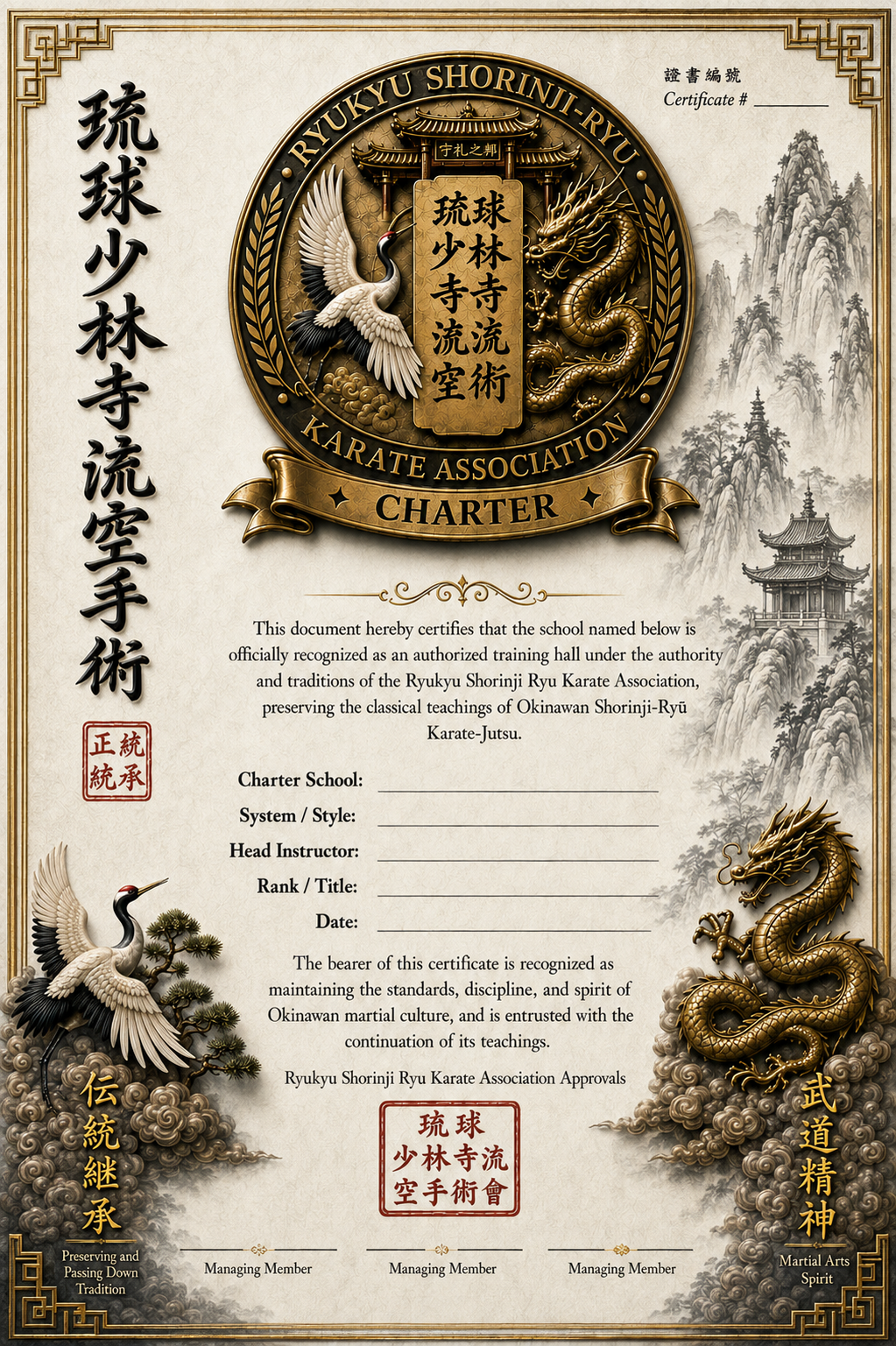
RSKA Charter Certificate
Approved schools may receive official Charter recognition representing their affiliation with the Ryukyu Shorinji-Ryu Karate Association.
Charter Membership
RSKA Charter membership is intended for instructors and schools that are prepared to accept the responsibilities associated with representing the Association.
Charter Schools are expected to preserve the integrity of the RSKA curriculum, maintain appropriate instructor and student standards, respect traditional Okinawan karate, and support the Association's mission of preserving the art for future generations.
Charter recognition is granted by the RSKA following review and approval. It is not intended to function simply as a commercial affiliation or branding arrangement.
The goal is to establish schools where students can train, progress, teach, lead, and continue the traditions of Okinawan karate with respect for those who came before them.
Charter Fees
RSKA Charter recognition is available under the following terms. The selected term determines the period of organizational recognition.
Additional fees may apply for optional services requested through the RSKA Hombu Dōjō, including rank certification or related certification services. Such services are separate from the School Charter fee and will be communicated to the applicant when requested.
Charter approval is separate from payment of the applicable fee. Payment of a charter fee does not guarantee approval; all applicants remain subject to the RSKA review and approval process outlined above.
RSKA Chartered Schools
View the schools currently recognized as RSKA Chartered Schools. The official Charter School Registry provides the current list of recognized schools and their associated information.
View the Chartered School Register
The RSKA Charter School Registry provides a centralized public listing of schools that have received official Charter recognition from the Ryukyu Shorinji-Ryu Karate Association.
View Chartered Schools →Ready to Apply for an RSKA Charter?
If you are an experienced black belt, instructor, or existing school interested in becoming an RSKA Chartered School, begin the official application process or contact the Association with questions before applying.
Preserve What Was Given. Teach What Was Learned. Pass It Forward.
The future of traditional Okinawan karate depends upon instructors who are willing to protect its traditions, develop its students, and carry its knowledge forward with discipline, respect, strength, leadership, and humility.